
Categories
Blog

Quest for the Ultimate Brownie

Growing up, one of our family life’s certainties was that my brother absolutely and categorically did not have a sweet tooth. This made baking for him extremely difficult as he often refused the more sweet or elaborate desserts I made. He did, however, like brownies. 

Thus ensued my many year relationship with perfecting the perfect brownie.

He, of course, had a few requirements. First and foremost the brownie had to taste like chocolate. The overriding flavour couldn’t be sugar or flour or heavens forbid – oil. A chocolate brownie had to punch deeply of chocolate and had to have the decadent fattiness that butter brings. So real chocolate (not just cocoa powder) was a must, as was butter (not oil). 

When in doubt, I went to Delia. 
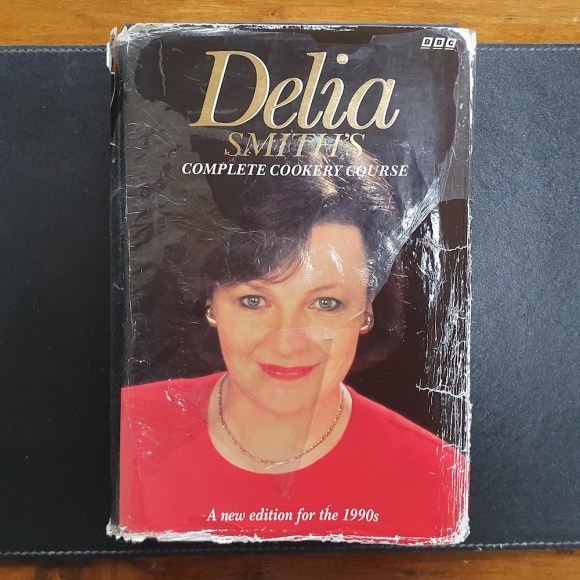
Delia Smith' Complete Cookery Course Book Cover

This extremely loved edition of Delia Smith’s Complete Cookery Course (a new edition for the 1990s!) was – and still persists as – a staple in my household. This was the first point of call when setting out to find a brownie recipe for my brother all those years ago. The recipe was good. But yielded a surprisingly small amount and was far too sugary for our tastes. 

So I tweaked it. 
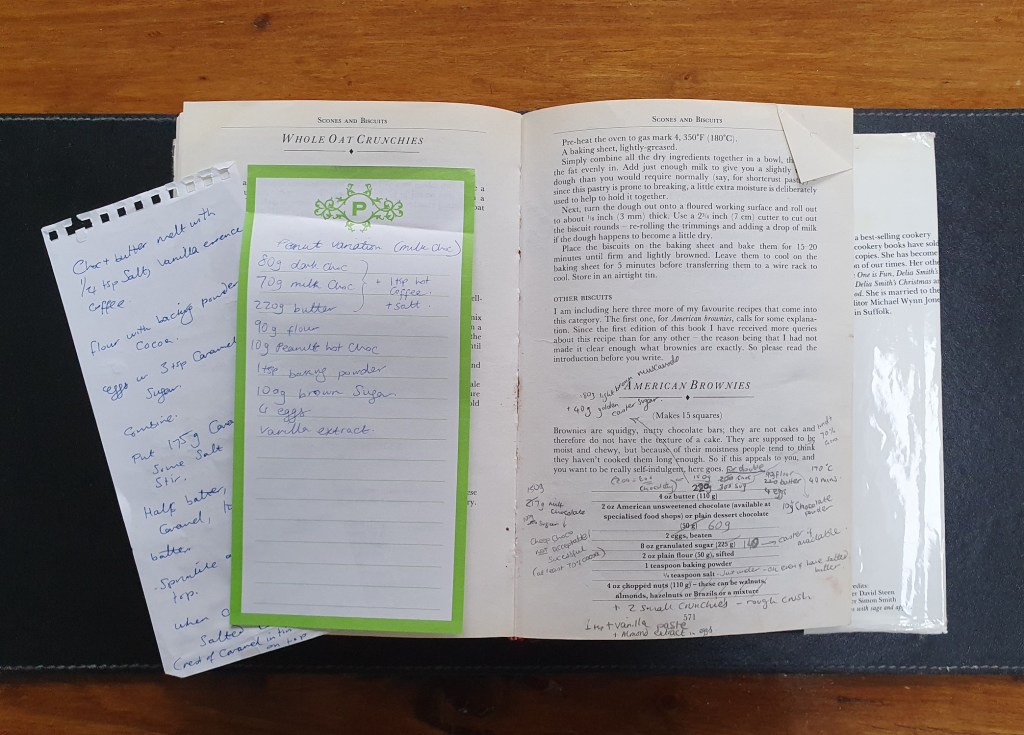
Delia Smith' Complete Cookery Course brownie recipe - marked up in pencil.

I cut down the sugar and used fine caster sugar instead of granulated. 

I upped the amount of chocolate because it wasn’t quite rich enough. 

I reduced the chocolate because it was far too much. 

I tried them with muscavado sugar because I wanted more complex toffee-caramel notes which the clean white sugar didn’t give. 

I doubled the recipe. 

I tried adding almond extract with the eggs. 

After Easter, when the only chocolates I had were the £2 large milk chocolate easter eggs, I tried making the brownies with those. (Spoilers – lovely in egg form but not as good in brownies.) 

I folded roughly crushed Crunches in the batter before baking (spoilers – really good). I added cocoa powder. I tried a salted caramel version. And a peanut butter one. (Excellent but needs perfecting.)

I even had a favourite brownie baking tin. It was beautiful. It was old and the enamel was chipped in places. It also curved outwards so the base was smaller than the lip of the tin which meant the shallower brownie mixture at the sides overcooked slightly and became chewy, a little bit crispy and a lot delicious. Unfortunately that tin was lost in my parent’s kitchen cull. Goodbye sweet brownie tin! Your brownies were legendary. I shall never forget you.

Over the years I tried, tweaked and re-tweaked it all.

Eventually I came to a recipe that vaguely looked a bit like Delia’s. If you squinted and raised an eyebrow. This recipe, if you’re curious is here: The Brownie.

It’s rich in chocolate and has just enough sweetness to confirm that yes – you are eating a sweet treat, without the whole situation being overpowered by sugar. It’s not squidgy and dense like some brownies are, but the texture is light and somehow melts in your mouth despite it being rich and decadent.

The process to make them is ridiculously simple. This is part of the reason why it sits in the Black Dog series. That, and the fact that a good brownie is one of the ultimate baking food comforts.

If you do try them out, I hope you enjoy eating them as much as we do.


Footnote: For those wondering, yes. Fast forward 20+ years and my brother has since broadened the catalogue of desserts he enjoys. However his favourite sweet treat steadfastly remains my brownies warmed in the oven and topped with a scoop of vanilla ice cream. It’s a family tradition now to make these brownies every Christmas holidays.

Categories
Blog

The importance of Indian sweets, or, my great-grandmother’s mishri

We Indians eat a lot of sugar.

When I say a lot, I really mean a lot. With English desserts, sugar is often disguised in the form of cakes and other carb-based vehicles that mask the sheer amount of butter and diabetes that’s gone into the production. Indian sweets do not even try. Jalebi is literally deep fried batter that’s soaked in orange-coloured sugar syrup until the structural integrity of the shell almost buckles under the weight of the syrup it’s absorbed. Soan papdi is a type of barfi (Indian sweet) that’s just layers and layers of spun sugar delicately balanced on top of each other. It’s given just enough substance by ghee and gram flour so that it’s substantial enough to eat but still dissolves on your tongue like caramel air. 

They’re all insanely delicious. In small quantities.

The reason we celebrate and have so many different forms of very sweet sweets is that in Indian culture, sweets are more than just quick hits of joy. They are deeply ingrained symbols of hospitality, welcome, and acceptance. When you go to someone’s house, especially for the first time, it’s considered inauspicious to leave until you’ve had even the tiniest bite of something sweet. There’s a punjabi expression which loosely means to ‘sweeten your mouth’ or to ‘leave a sweet taste in your mouth’ which is often repeated in a tone which brooks no dissent to reluctant guests who have already declined the offer of a more substantial meal. 

The theatre of offering – and accepting – a sweet is no little act. It’s an extension of giving – and accepting – love. To reject even eating the smallest morsel at someone’s home? Well, if offering sweets is a symbol of deep love and welcome, then rejecting it is akin to leaving your shoes on when you enter that person’s home and then proceeding to wipe the mud onto the carpet in the ‘formal’ living room reserved only for guests. In short, it’s extremely disrespectful and hurtful. 

But for all these elaborate Indian sweets, the sweet that holds a special place in both my heart and memory is the humble, frosted-white lump of rock sugar about a centimetre in size called mishri. 

My great-grandmother used to keep a white plastic tub about three or so inches tall and about the same wide, full of these hard treasures. It was mixed with small white nakul dana (which Google informs me is ‘mimosa sugar balls’ in English) and, sometimes, random green cardamom pods. Whenever my brother and I – and even my cousins on both dad and mum’s side – came over, we always had permission to reach over to her bedside table and pop open the lid; maneuvering carefully to avoid knocking over the black-and-white photo frames of people I’d never met, along with her collection of medicine bottles.

I never liked those opaque nakul dana that contaminated the mishri because they tasted soft and powdery. They were, in my young opinion, definitely the lesser of the two sweets and were the punishment you had to endure in order to get at the real prize. When I was small, I soon developed a trick of shaking and wiggling the pot so that the majority of sweets that tipped into my open palm were the mishri. Foiling those dastardly white balls.

There is nothing particularly special about the mishri when compared to all the wonderful barfia you can buy in Indian sweet shops. At the end of the day the mishri was just a rock of unflavoured white sugar that occasionally tasted of cardamom. Because of this we were only allowed a small amount as a treat to ‘sweeten our mouths’. But even so, slowly melting and crunching mishri is an experience tied indelibly in my memory to my great-grandmother. To her love, warmth, and welcome toward everyone that visited her home.

She was 94-96 when she died. We don’t know her exact age as record keeping in India in the 1910s was not a thing. Even though she passed over a decade ago, whenever I see mishri, I think about her. As most of you know, you never really stop missing someone who you loved and who loved you back. All you can really do is eat the mishri, and hope you live long enough to have your own pot to offer to your great-grandchildren while they politely listen to your stories and indulge your requests to massage your achingly old arms and legs. Waiting for their prize.