Categories
Blog

“Recommended” Ingredients?

You’re Indian now, quantities don’t really exist.

The majority of Indian recipes on this site will use a “recommended” ingredients list. This is because home-cooked Indian food isn’t like some other cuisines: where if you don’t fold in the egg whites correctly your soufflé won’t rise, or your panna cotta will absolutely not set if you use too little gelatine. Indian food is more fluid and should be adapted to what tastes good to you.

When I was learning how to make Indian dishes, older family members would say (while adding an undefined amount of salt and a large pinch of spices): “add as much as you need” or “until it looks right”. Now, I appreciate making something look or taste right is hard to do when you don’t know what ‘right’ should be. So the recommended ingredients list, and subsequent method, will help you define this.

The ingredients list should start out as your base to create a meal that tastes good but as time goes on, this should serve as an anchor for you to experiment with your own flavour amounts. Typically when my extended family and I make food, there aren’t any quantities to be found (sometimes to my frustration as my food is never as good as my grandma’s – I honestly think she adds things when we’re not looking!), and no two attempts are ever the same. It depends so much on the strength of your ingredients and what you feel like making it taste like. 

I joked on a blog post on making ‘proper’ Indian tea that: “You’re Indian now, quantities don’t really exist”. To an extent, that’s where I’m coming from. Home-cooked Indian food is vey much about feeling that quantity, so I encourage you to feel and taste while you cook. If you follow the recommended list and method, you shouldn’t go too far wrong in your adventures. 

Good luck!

Categories
Blog

The importance of Indian sweets, or, my great-grandmother’s mishri

We Indians eat a lot of sugar.

When I say a lot, I really mean a lot. With English desserts, sugar is often disguised in the form of cakes and other carb-based vehicles that mask the sheer amount of butter and diabetes that’s gone into the production. Indian sweets do not even try. Jalebi is literally deep fried batter that’s soaked in orange-coloured sugar syrup until the structural integrity of the shell almost buckles under the weight of the syrup it’s absorbed. Soan papdi is a type of barfi (Indian sweet) that’s just layers and layers of spun sugar delicately balanced on top of each other. It’s given just enough substance by ghee and gram flour so that it’s substantial enough to eat but still dissolves on your tongue like caramel air. 

They’re all insanely delicious. In small quantities.

The reason we celebrate and have so many different forms of very sweet sweets is that in Indian culture, sweets are more than just quick hits of joy. They are deeply ingrained symbols of hospitality, welcome, and acceptance. When you go to someone’s house, especially for the first time, it’s considered inauspicious to leave until you’ve had even the tiniest bite of something sweet. There’s a punjabi expression which loosely means to ‘sweeten your mouth’ or to ‘leave a sweet taste in your mouth’ which is often repeated in a tone which brooks no dissent to reluctant guests who have already declined the offer of a more substantial meal. 

The theatre of offering – and accepting – a sweet is no little act. It’s an extension of giving – and accepting – love. To reject even eating the smallest morsel at someone’s home? Well, if offering sweets is a symbol of deep love and welcome, then rejecting it is akin to leaving your shoes on when you enter that person’s home and then proceeding to wipe the mud onto the carpet in the ‘formal’ living room reserved only for guests. In short, it’s extremely disrespectful and hurtful. 

But for all these elaborate Indian sweets, the sweet that holds a special place in both my heart and memory is the humble, frosted-white lump of rock sugar about a centimetre in size called mishri. 

My great-grandmother used to keep a white plastic tub about three or so inches tall and about the same wide, full of these hard treasures. It was mixed with small white nakul dana (which Google informs me is ‘mimosa sugar balls’ in English) and, sometimes, random green cardamom pods. Whenever my brother and I – and even my cousins on both dad and mum’s side – came over, we always had permission to reach over to her bedside table and pop open the lid; maneuvering carefully to avoid knocking over the black-and-white photo frames of people I’d never met, along with her collection of medicine bottles.

I never liked those opaque nakul dana that contaminated the mishri because they tasted soft and powdery. They were, in my young opinion, definitely the lesser of the two sweets and were the punishment you had to endure in order to get at the real prize. When I was small, I soon developed a trick of shaking and wiggling the pot so that the majority of sweets that tipped into my open palm were the mishri. Foiling those dastardly white balls.

There is nothing particularly special about the mishri when compared to all the wonderful barfia you can buy in Indian sweet shops. At the end of the day the mishri was just a rock of unflavoured white sugar that occasionally tasted of cardamom. Because of this we were only allowed a small amount as a treat to ‘sweeten our mouths’. But even so, slowly melting and crunching mishri is an experience tied indelibly in my memory to my great-grandmother. To her love, warmth, and welcome toward everyone that visited her home.

She was 94-96 when she died. We don’t know her exact age as record keeping in India in the 1910s was not a thing. Even though she passed over a decade ago, whenever I see mishri, I think about her. As most of you know, you never really stop missing someone who you loved and who loved you back. All you can really do is eat the mishri, and hope you live long enough to have your own pot to offer to your great-grandchildren while they politely listen to your stories and indulge your requests to massage your achingly old arms and legs. Waiting for their prize.

Categories
Blog

Proper Indian Tea

I published this tongue-in-cheek recipe on Imgur about a year or so ago. It was, in part, the inspiration for this website so I thought it was only fitting I post it here for your amusement. I’ve edited it slightly from my original. Please take the mock-outrage as intended. My sympathy goes out to all the Lars’ out there trying to make a living.

Proper Indian Tea.

Not like that stuff you get on all those hipster articles (what even is that and why are you putting in golden syrup and fake sweeteners? Do you think my great great grandma had golden syrup in the village in the 1800? Sure you say it tastes better than actual indian tea – you in your stretchy gold spandex as you come out of a hot goat yoga lesson, led by a man named Lars who ‘found’ himself and his ‘Namaste Chakra tea’ on his gap year to the mountains – but in reality he was just high most of the time and when he wasn’t he was on the loo with chronic, and surprisingly violent, diarrhoea.)

Wet Ingredients:

  • 1 part water to 2 parts milk

Don’t even come to this with semi-skimmed. Full-fat or better yet, gold top. ‘Skimmed’ I hear whispered? Get out.

Dry Ingredients:

  • Black tea – 1 tea bag for every 2 people or loose tea equivalent
  • Cloves – 1 per 1-2 people. Add an extra one to the pot if you’re feeling spicy
  • Green cardamom – 1 per person 
  • Black cardamom – get you with your varieties of cardamom! 1 or 2 seeds if you have it
  • Star anise – break off one leg, 2 legs when you get to 5 people. Optional but seriously, what else are you going to do with that year old jar? 
  • Cinnamon stick – break off a 2 inch strip for no matter how many people, unless it’s more than 6. Smell it and realise the cinnamon stick is all dried up and lacking any flavour. Stick it in the pot anyway because it might help. Get the cinnamon powder out.
  • Cinnamon powder – eh, like, a small 1/4 tsp for 2-3 people. You’re Indian now, quantities don’t really exist.
  • Ginger powder – more than the cinnamon powder but not crazy. A bigger 1/4 tsp. But not 1/3 tsp, that’s too much. You don’t want to choke on ginger. That’s too spicy.
  • Fennel seeds – a good pinch. It’s sweet and good for digestion.
  • Ajwain seeds (bishops weed/lovage) – bitter. A tiny sprinkle.

Method:

1. Get a milk pan that’s large enough to hold how much tea you want.

Make sure it has a handle and spout unless you want boiling tea all over the counter, 1st degree burns, and your mum giving you a slap for wasting all that tea.

2. Put cold tap water in the pan and set on the heat. Add all the spices and wait for them to get to know each other. Simmer for a couple of minutes. The water should have changed colour and you should smell the spices. 

3. Add the tea bags/equivalent loose tea and then quickly add your milk.

4. Let the tea simmer for 5 mins. And when I say ‘simmer’ I mean you’re half afraid that if you take your eye off it, it’ll come up and overflow. You should be in a state of constant low level panic. Like Christmas.

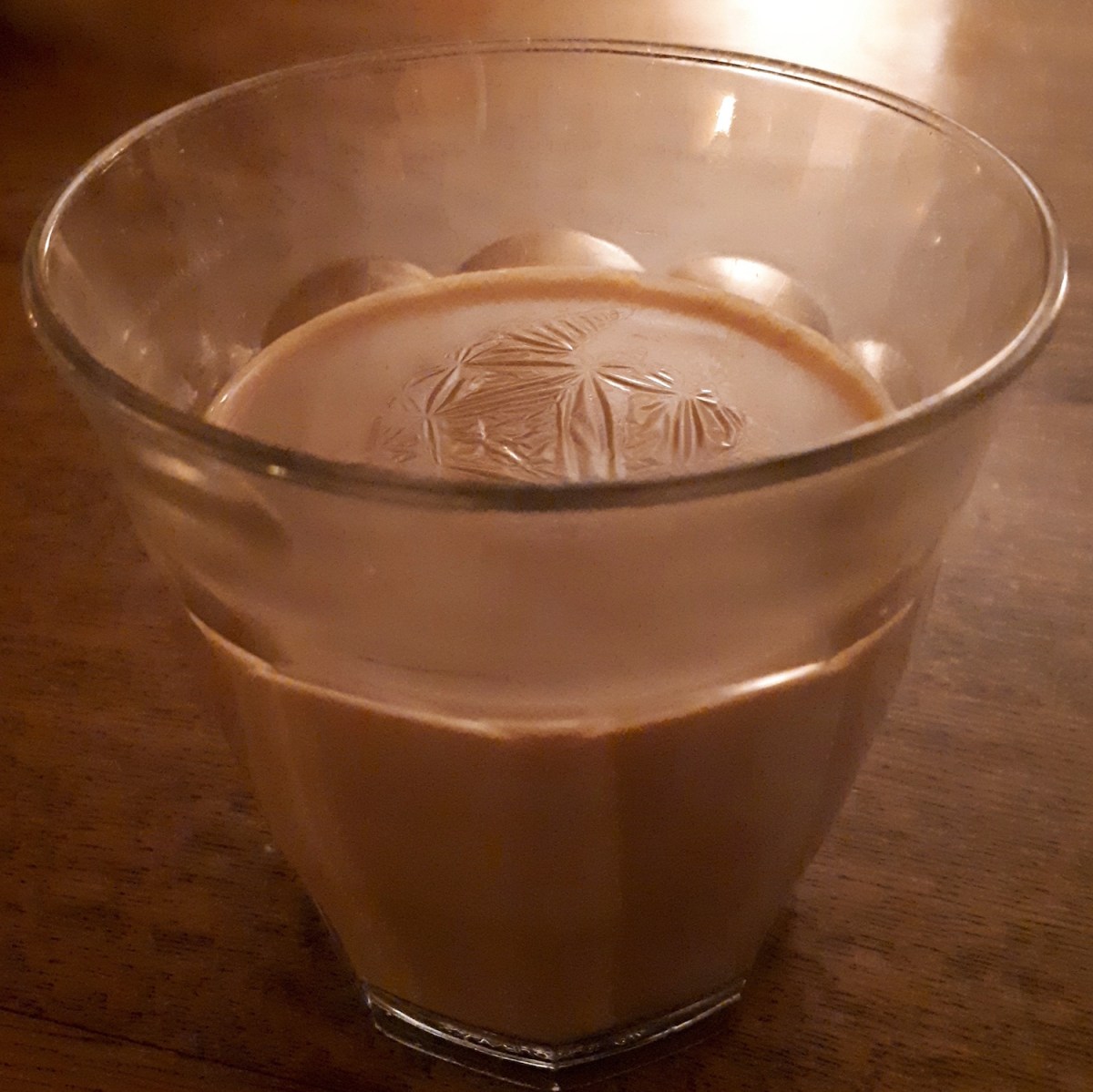
5. Strain into mugs (or heat proof glasses if, like me, all your mugs are in the dishwasher. Burning your hand on glass is more authentic anyway), taking the teabag out first because you quickly realise that causes major strainer blockage. 

6. Sweeten with sugar to taste. Get that golden syrup away from here. Enjoy with smugness.

Tip: I recently became intolerant to cow’s milk. To my deep sadness. The best milk alternative I’ve found is Oatly’s ‘barista’ oat milk. It’s not quite the same as cow’s milk, but it’s satisfyingly creamy and makes a different, but equally fantastic, cup of chai.